Five things everyone believes about SOC 2® that cost real money.
Compliance folklore spreads faster than compliance knowledge, mostly because the accurate version is boring and the inaccurate version fits in a Slack message. Here are the five we hear most from founders, and what is actually true — no gate, no form, no call.
Believed vs. actually
None of these are stupid beliefs. Four of the five are things a vendor was happy for you to think.
-
01
Believed
"SOC 2 means a company is secure."
ActuallyIt means an independent CPA firm examined the controls you chose, against criteria you scoped, over a period you picked. It is evidence of discipline, not a force field. Which is also why the buyer reads the report rather than the badge.
-
02
Believed
"We need to hire a compliance person first."
ActuallyAt under fifty people you need a finite list, an owner per item and somewhere for the evidence to land. A full-time hire at this stage is usually a very expensive way to buy a project plan you could have had for the price of a laptop.
-
03
Believed
"The platform gives you the report."
ActuallyNo platform can. The report comes from an independent CPA firm, billed separately, and that independence is the entire reason anyone accepts it. Software gets you ready; it does not get to grade the homework.
-
04
Believed
"Type II takes a year, so we will start next year."
ActuallyThe observation window is a choice — three months is common for a first Type II, and a Type I looks at a single point in time. The year you lose is the one spent deciding to start. The clock only runs once the controls are actually operating.
-
05
Believed
"Once it is done, it is done."
ActuallyThe evidence window for the next report starts roughly the day the last one ends. Teams that treat it as an annual sprint pay for the same archaeology every year; teams that let it run in the background mostly stop noticing it.
What compliance actually costs a small team
Rarely the software. Almost always the four things below, and three of them do not appear on any invoice.
Reconstructing the past
Proving what access looked like eight months ago, from memory and calendar invites. This is the single most expensive activity in a first audit and it produces nothing of value.
Engineering hours
Your most expensive people taking screenshots. Every hour spent proving the work is an hour not spent doing it — and they will not enjoy either.
The waiting deal
A signed contract sitting in security review for six weeks costs more than any tool in this category. Nobody books that number anywhere.
Doing it twice
Starting ISO 27001 from an empty folder because the SOC 2 work lived in a consultant's laptop. The second framework should be a gap exercise, not a rerun.
Watch how carefully we describe our own SOC 2®
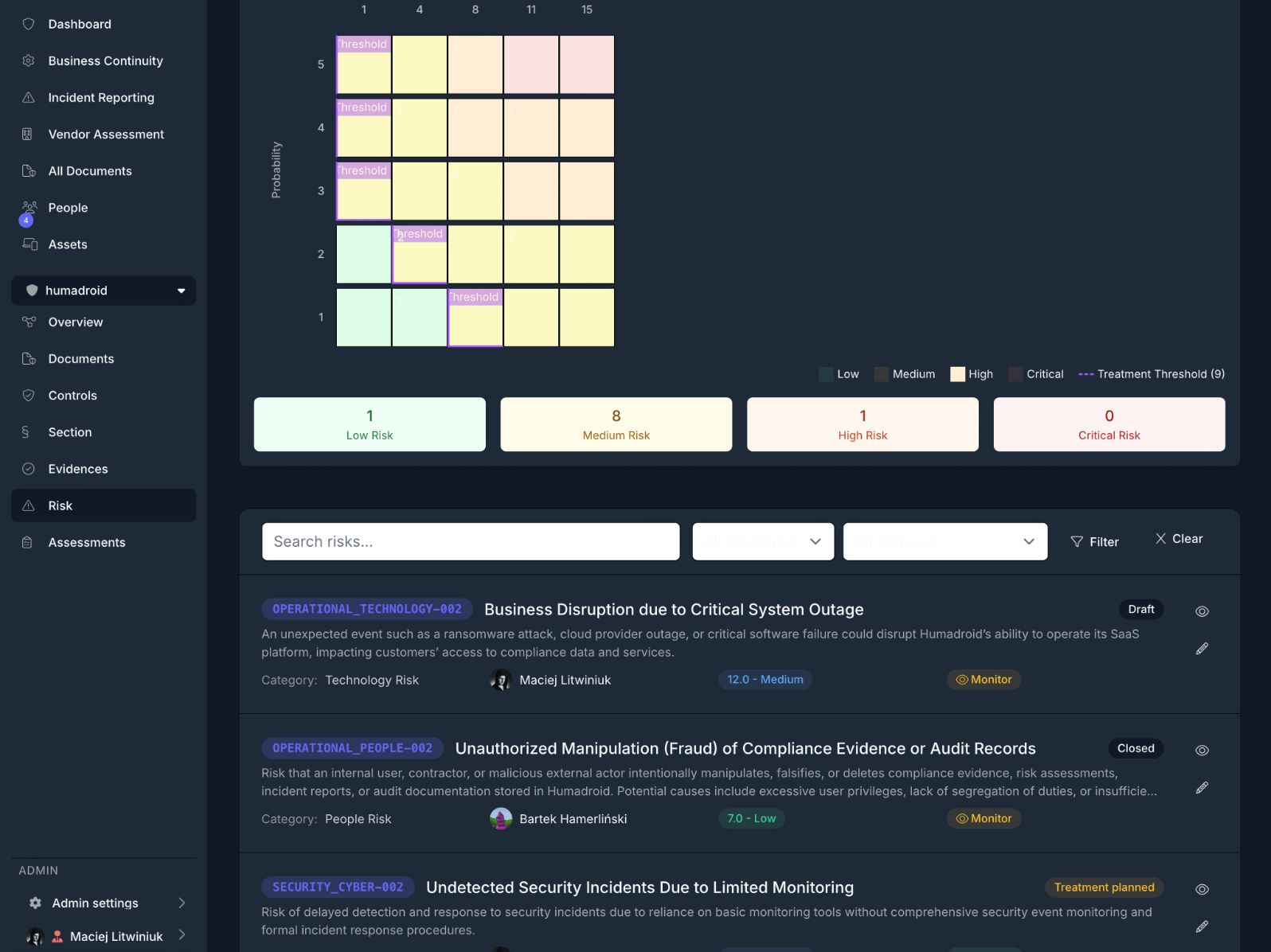
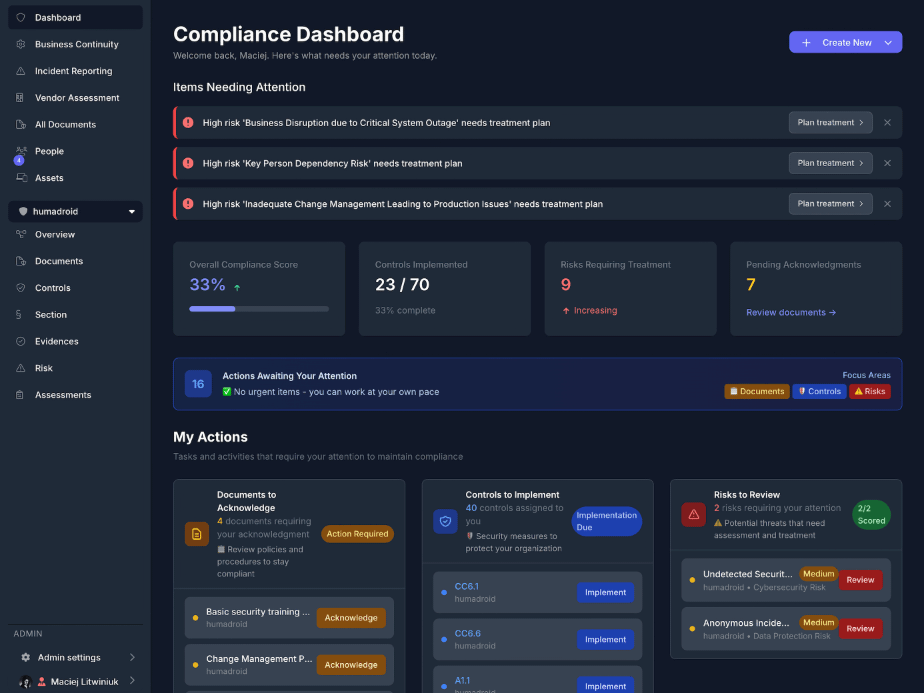
AuditBadger has completed its own SOC 2® Type II examination, and the whole program — controls, evidence, policies, risks — lives inside the product. Notice the words we did not use.
- "SOC 2 certified" — there is no such certificate.
- "We passed SOC 2" — it is an examination, not an exam.
- "Fully compliant" — with what, as of when, examined by whom?
- "Completed a SOC 2® Type II examination."
- "Controls examined by an independent CPA firm."
- "Here is the report — ask and we will tell you how to get it."
This is not pedantry for its own sake. A vendor careless with attestation language on their own website is a vendor who will be careless with yours, and your buyer's security reviewer notices the difference immediately.
How we run our own programA page about precise language, on a domain with the wrong brand in it
Fair. Humadroid is what we were called before the compliance product became the whole company and turned into AuditBadger. The domain is still ours and we send a little cold mail from it, deliberately spread across a few domains, so that one filter having a bad week cannot silence the business.
Everything current lives at auditbadger.com — including the version of this written for seed-stage teams. If our email was not welcome, reply and say so; a founder reads it.
Fewer myths, shorter list
One flat price, unlimited users, onboarding run by the founders. Or take the free policy generator and start with the part everyone puts off.
Want to argue with any of the five? Book a founder demo — we like that conversation.